 Jotform
Mutual NDA Template
Two-way mutual non-disclosure agreement where both parties exchange confidential information, with mutual definitions, obligations, term, and dated signatures.
Available online on
Download as
- Free PDF and Word downloads for offline use
- Fillable fields you can customize for your business
- Share a link or print copies for in-person sign-ups
- Ready-made online forms on popular form builders
Last updated July 18, 2026. Reviewed by the Online Signature Forms team.
About this template
A Mutual NDA — also called a bilateral or two-way NDA — protects confidential information flowing in both directions. Unlike a one-way NDA, where only one side shares secrets, a mutual NDA treats each party as both a disclosing and a receiving party, so both are bound to protect what the other reveals. Companies exploring a partnership, a merger, a joint product, or a reseller deal reach for this document because each side needs to open its books, roadmaps, or technology to the other. Typical fields include both party names and addresses, a mutual definition of confidential information, the shared obligations, the term, and a dated signature block for each side.
As with any NDA, the protection comes alive only at signature: an unsigned draft binds no one, while a signed and dated copy gives both sides a record they can rely on. That is why this layout keeps the mutual definitions and obligations readable and places the two-party signature block at the very end, with signature, printed name, and date lines. To be clear, this is a general-purpose layout with the sections most mutual NDAs need — it is not legal advice. Confidentiality terms vary by state, so have an attorney review the wording before you rely on it for a significant deal.
How teams use this agreement
Two startups considering a product integration sign a mutual NDA before comparing their APIs and user data. A company and a potential acquirer sign one before due diligence, so financials and customer lists stay protected on both sides. Two agencies forming a joint venture sign before pooling client strategies. In every case, because information moves both ways, a single mutual agreement is cleaner than trading two separate one-way NDAs.
Define what is confidential before signing
The heart of a mutual NDA is a definition of confidential information that applies equally to both parties — product plans, financials, technical data, customer information, and anything marked confidential. List the shared exclusions too, such as information that is already public or independently developed. Open the Word (DOCX) download to edit these clauses, set the permitted purpose of the discussions, and adjust the term. The fillable PDF is ready to complete and sign as-is.
Common mistakes to avoid
Do not write the definition to favor one side — in a mutual NDA the obligations must be symmetric. Do not forget the term, and state clearly whether it survives the end of the discussions. Do not skip the return-or-destroy language covering both parties' materials. And remember that both signatures and dates are required for the agreement to bind either side.
Example scenario
Two software companies want to explore bundling their products. Before either shares its roadmap, they sign this mutual NDA naming both as disclosing and receiving parties, define their respective technical and financial details as confidential, set a three-year term, and agree to return materials if talks end. Both sign and date two copies, and each keeps one before the first data exchange.
Choosing PDF or Word
This page offers a printable fillable PDF and an editable Word (DOCX) file. Use the Word file when you need to fine-tune the mutual definitions, purpose, or term before printing, and the PDF when the terms are settled and you just need to fill and sign. Both include a dated, two-party signature block so the mutual NDA is ready to execute the moment both sides sign.
Typical fields
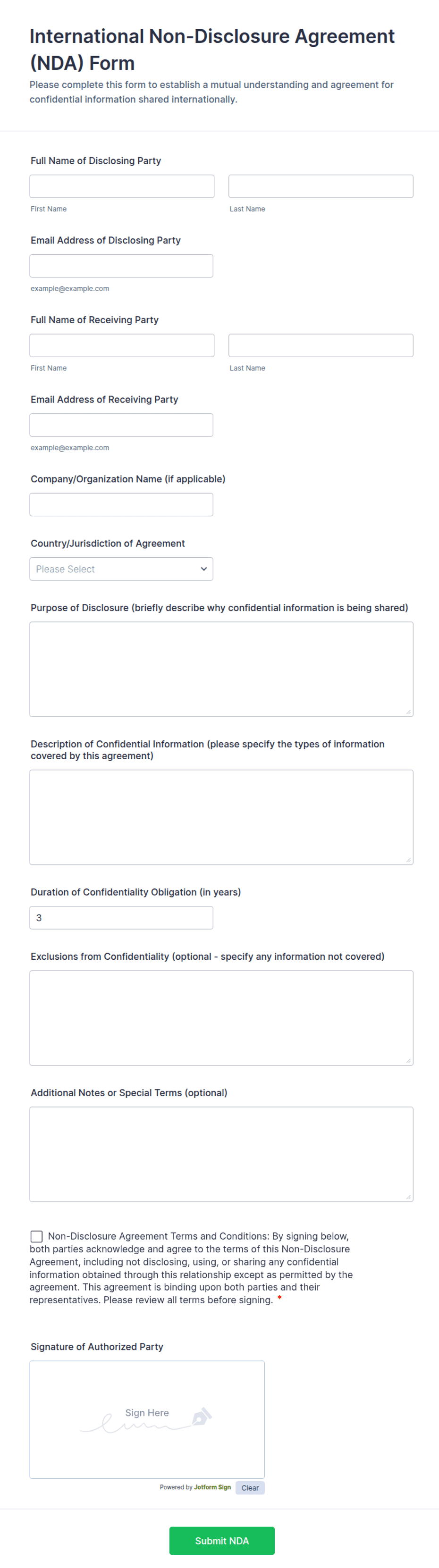
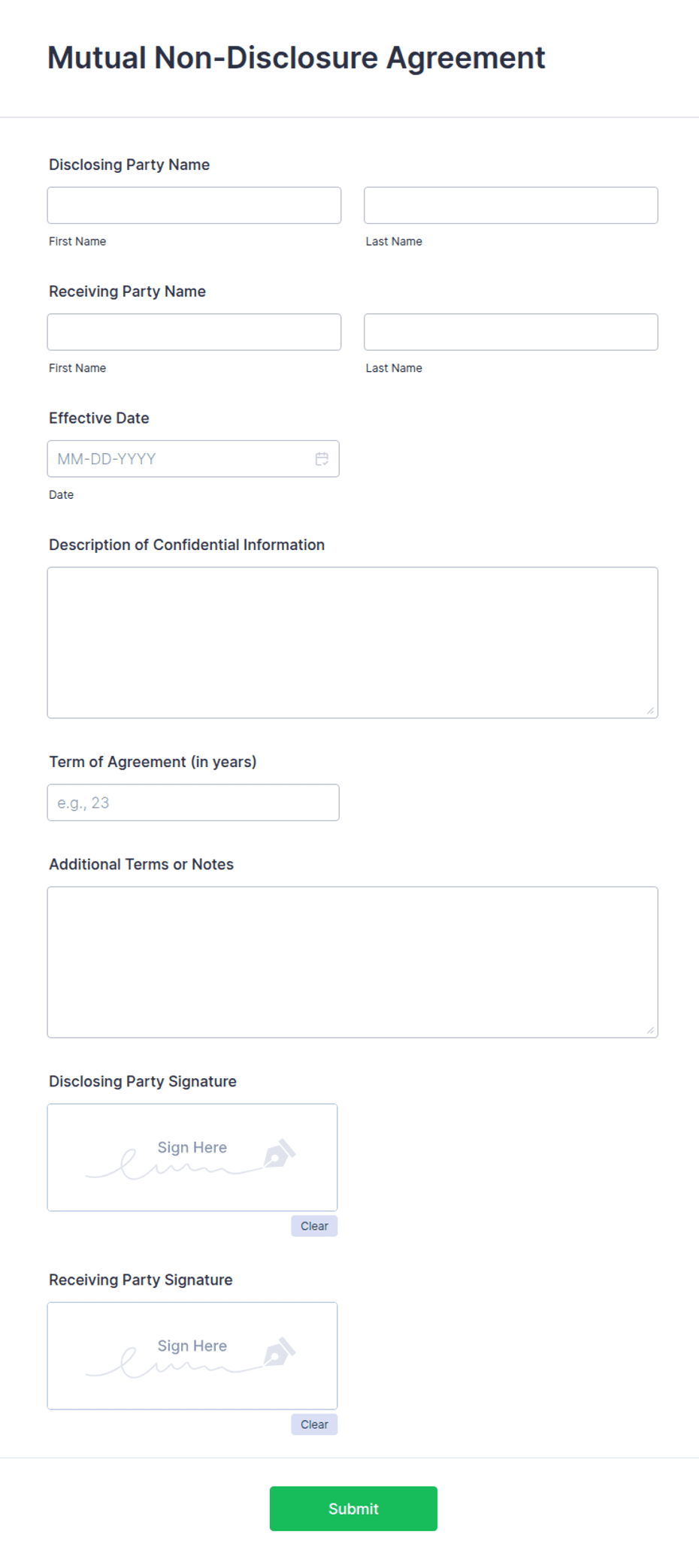
- First party name and address
- Second party name and address
- Mutual definition of confidential information
- Purpose of the disclosure / discussions
- Obligations of both parties
- Exclusions from confidential information
- Term / duration of obligation
- First party signature, printed name, and date
- Second party signature, printed name, and date
Best for
- Companies exploring a partnership or joint venture
- Mergers, acquisitions, and due diligence
- Product integrations sharing technical data
- Any two-way exchange of confidential information
When to use PDF vs online
Use the PDF or Word download for in-person sign-ups, fax, or email attachments. Choose an online form when you need automatic notifications, payment integrations, or a shareable link for customers.